The role and importance of LPG in Poland
2.3.2026
What significance does LPG have for the Polish economy? LPG is the energy that drives the daily life of the economy. It's not just 3 million cars powered by autogas and heating for 150,000 households. A new report by WiseEuropa indicates that LPG is the work of 300,000 people throughout Poland and more than PLN 3 billion in taxes flowing into the State Treasury.


February 17, 2026 As part of the webinar of the Polish Liquid Gas Association and the WiseEuropa Institute, a new report was presented entitled LPG industry: Role and importance in the Polish economy. The event was attended as speakers by the authors - Krzysztof Bocian and Maciej Bukowski - and the results were commented by experts, Alexandra Helbin, editor-in-chief of wnp.pl portal and Kamil Sobolewski, Chief Economist of Employers of the Republic of Poland. Introduction to the discussion presented Bartosz Kwiatkowski, CEO of POGP.
The global LPG market is dynamic and geographically diverse, with the rapidly growing importance of the US as a major producer and China as the largest consumer. Thanks to the so-called shale revolution, LPG production in the US has increased in recent years by an average of 9% per annum and further growth is expected in the next decade - all the surplus is likely to go to exports, as the US domestic market is saturated and has remained at a stable level of consumption for years. Production is also growing in Canada, which sends the extracted liquefied gas to East Asian countries.
Exports from Algeria and the Gulf countries have also increased in recent years. Algeria supplies mainly customers in the Mediterranean - Spain, Italy or Turkey - and the Gulf states primarily India, China and Southeast Asia.
LPG is used in many sectors: chemical, transport, heating, catering, agriculture, industry and even in the aerospace industry. Its use as a refrigerant in refrigerators, freezers, heat pumps or air conditioning units is often wrongly overlooked, although it is growing with the popularity of small household appliances. It is also useful as a fuel for rapid response in emergency situations - for example in the conditions of natural disasters (Japan, Haiti, Indonesia, New Zealand and many others). In Poland, it was used in reception points for refugees after the start of Russia's full-scale invasion of Ukraine in 2022 and after the flood in Lower Silesia in 2024.
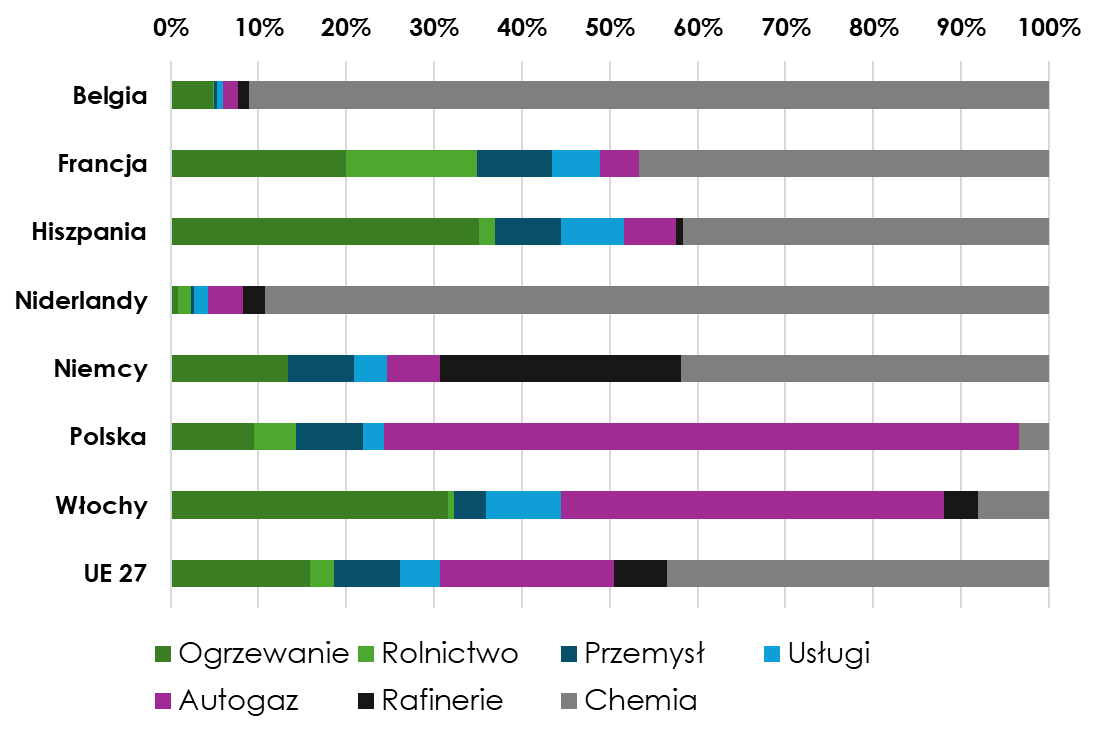
In the countries of the European Union, the structure of LPG consumption varies greatly. The Polish market resembles the Turkish market, with the predominance of autogas in consumption. Poland and Italy are responsible for ¾ cars powered by autogas in the territory of the Union. Other countries widely use LPG for heating homes, mainly due to the lack of a developed heating network and the predominance of rural areas (France) and hard-to-reach (Spain, Italy) - e.g. mountain ranges. Germany is the largest user of liquefied gas in the petrochemical segment, and the Netherlands and Belgium - small and highly urbanized countries - widely use it in the chemical industry.
Poland stands out from Europe with a particularly high share of LPG in transport. LPG fuels every eighth passenger car on Polish roads, heats houses, is used to prepare meals — every day, on the plot, or during barbecue, the national sport of Poles. It is used by the catering industry — in bakeries and pastry shops, in popular food trucks and for heating gardens. It is used by roofers on roofs and road workers when laying asphalt. In agriculture, it is used to heat greenhouses and chicken coops, as well as for drying crops. It was widely used in providing emergency relief to the flood victims and refugees from Ukraine. In industry, it is a substitute for natural gas, it is also used for the production of aerosols and assembly foams. It also powers generators in hospitals or shelters, and as a refrigerant it is used in air conditioners, refrigerators, freezers and heat pumps.

— The report on the impact of LPG on the economy prepared by the think tank WiseEuropa was created to show the importance of LPG for the Polish economy. The role of liquefied gas in rural areas is also important. There are places in Poland where gas infrastructure does not reach, and low-voltage networks often fail. It is there — in hard-to-reach, mountainous and sparsely populated areas — that the advantages of liquefied gas as a cheap and convenient source of energy are fully revealed. LPG provides energy security and additional support in the event of a critical infrastructure failure — comments Bartosz Kwiatkowski, General Director of the Polish Liquid Gas Association (POGP).
“LPG is predictability: a mature, stable and resistant to turbulence market. There is also a real economy behind LPG. The sector drives nearly 300,000 jobs spread across the economy — from refineries, distribution and storage, to tank manufacturing, to auto repair shops and service stations. More than 70% of employment is related to the transport sector, which accounts for ¾ of the national consumption, and LPG is the third most important fuel in Poland. In addition, 15% of liquefied gas is consumed by households for heating and heating meals. Economically, LPG meets the characteristics of a fuel: cheap, accessible, easy to store and transport, and flexible — adds Krzysztof Bocian, expert at WiseEuropa.
LPG remains the third most important transport fuel in Poland with a share of more than 8 percent of total sales. It also maintains a sustainable position as one of the key fuels in the national energy mix — in particular, it is difficult to replace in areas with underdeveloped grid infrastructure.

The share of Russian LPG imports in total imports to Poland decreased from 75% in 2019 and 45% in 2024 to around 13% in November 2025, and in 2026 it will not be legally allowed to be imported at all. This is the fastest and most radical change in fuel supply directions in history. It is worth noting that this revolution did not significantly affect fuel prices for customers, which was the result of the efficient operation of LPG distributors in terms of diversification of suppliers. The situation should not change in 2026 either.

LPG is a global fuel. Poland has gone from being a passive recipient of gas from the East to an active hub, fully integrated into the world market. Current deliveries are driven by marine terminals, and the main stream of LPG reaches us from the ports of ARA (Amsterdam-Rotterdam-Antwerp) and Scandinavia. The so-called 'Rotterdam Effect' is taking place, because although it appears in the statistics as an import from the EU, its primary source of origin is the United States, and American gas already accounts for almost half of our imports and it is this that is beginning to shape prices in our market. From an economic perspective, this means more than diversification. Poland has become a market permanently linked to European and global logistics, with the growing role of maritime infrastructure, with prices shaped by global phenomena and not by Russian suppliers. LPG has become today one of the most reliable liquid fuels in Poland from the perspective of energy security.
Kamil Sobolewski Employers of the Republic of Poland added that the use of LPG brings tangible benefits for drivers and the entire Polish economy, significantly reducing expenses for fuel imports. According to his estimates, the statistical driver driving on LPG saved in 2025 about PLN 4,200 per year, assuming the cost of LPG installation at the level of approx. PLN 5,000, which means a return on investment after the first year.
On the economic scale, assuming the annual consumption of autogas at the level of less than 1.9 million tons worth PLN 3.2 billion per year, the savings for the country due to the avoided import of more expensive gasoline is PLN 2.3 billion per year. Driving on gas reduced Poland's trade deficit by 9% in 2025 and its current account deficit by 15%
What will the future bring?
The maximum level of autogas consumption in Poland was probably reached in 2023, 4 years earlier than forecast by the Government Agency for Strategic Reserves. The data for 2024 and the forecast for 2025 indicate a mild downward trend. This phenomenon is primarily due to the growing popularity of hybrid cars, which already account for about 40% of new registrations and, like autogas, allow to reduce the cost of use.
Growth potential for the market should be seen in the household and industrial segments. Residential buildings in rural areas still have a large share of solid fuels (coal and wood), which will be replaced by cleaner energy sources such as gas and electricity. Agriculture and industry, including food processing, will remain important customers. The proliferation of BioLPG in the coming years could contribute to the complete decarbonisation of the industry, which will allow the use of renewable liquefied gas for decades to come — an important link in ensuring energy security and system stability during the transition period.
More information in the report entitled. LPG industry: Role and importance in the Polish economy, and the full transcript of the webinar can be found on the POGP Youtube channel: