Open Letter to the President of the French Republic
23 March 2022
In the context of ongoing work on the Fit for 55 package – with particular regard to the draft regulation amending the regulation setting CO2 emission standards for new passenger cars and new light commercial vehicles (2021/0197 (COD)) – 14 industry organizations have published a joint open letter to the President of the French Republic. President Emmanuel Macron chairs the work of the Council of the European Union until the end of June 2022.


On 17 March the industry organizations Liquid Gas Europe, Advanced Biofuels Coalition, Methanol Institute, ePure, CLEPA, FEDIOL, EBB, Fuels Europe, NGVA, FETSA, Sustainable Fuels, CO2 Value Europe and Copa Cogeca jointly addressed to the French Presidency an appeal for support for the development of renewable and low-carbon transport fuels. The signatories of the letter call above all for preserving the possibility of selling on the European market vehicles powered by internal combustion engines that use fuels meeting the criteria set out in the directive on the promotion of energy from renewable sources. The document states, among other things:
The industry needs a strategic framework in the form of coherent and interdependent policies reaching beyond the horizon attainable for the Directive on the promotion of energy from renewable sources (RED). (…) At present the strategy for road transport is driven by policy on carbon dioxide emission standards for cars, measured at the tailpipe – which by design rules out the development of any fuels containing carbon of biological or waste origin.
The French Presidency of the Council of the European Union offers a unique chance to hold a fair and open debate on the key role of renewable and low-carbon fuels, in particular in the road transport segment. Such a debate could help produce a strategy, consistent with the political and legal framework, for a functioning market that is essential to trigger the necessary investment. At the same time, one should refrain from excluding any technology a priori and instead mobilize all available technologies that can contribute to achieving climate neutrality in 2050.
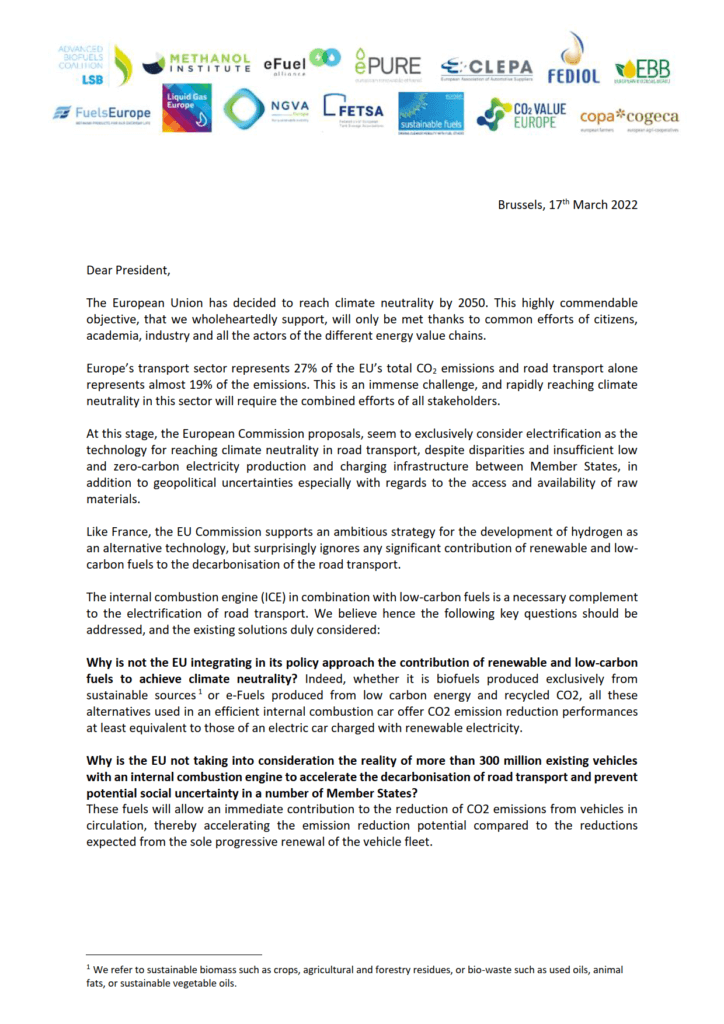
The full text of the appeal can be read here.