New Pressure Equipment Regulation Enters into Force
13 January 2022
On 12 January the new Regulation of the Minister of Development and Technology of 17 December 2021 on the technical conditions of technical inspection for certain pressure equipment subject to technical inspection (the pressure regulation) was published in the Journal of Laws under item 68.

This regulation will enter into force on 27 January 2022 and will replace in its entirety the previous Regulation of the Minister of Economy, Labor and Social Policy of 9 July 2003 on the technical conditions of technical inspection with regard to the operation of certain pressure equipment.
Because of the technical complexity of the subject matter, work on the new regulation went on for many years, and the Polish Liquefied Gas Organization took part in it from the very beginning. From the point of view of participants in the LPG liquefied gas trade, the most important points of the regulation include:
- The regulation applies to fixed tanks and to process pipelines within an industrial facility; it also applies to portable tanks, but it has been settled that it does not apply to tanks operated as transport pressure receptacles within the meaning of the regulations on the carriage of dangerous goods (that is, gas cylinders).
- The regulation does not cover equipment previously covered by the regulation, such as tankers or equipment for filling and emptying transport tanks; as regards tankers, we have no doubt that they will be inspected under the procedure laid down in ADR, while in the case of filling and emptying (NO) equipment we will still be establishing this.
- The regulation expressly states that its provisions on design and manufacture do not apply to equipment covered by EU harmonization legislation, e.g. the Pressure Equipment Directive 2014/68/EU. Such equipment – for instance fixed liquefied gas tanks – falls under the jurisdiction of the Polish technical inspection bodies only at later stages of the equipment's life.
- Section V describes the procedure for submitting applications for a permit to operate technical equipment, as well as the list and content of the documents required for this purpose. The possibility of submitting applications and of communicating in electronic form has been expressly allowed. I recommend the entire text on pp. 6–9 of the regulation enclosed herewith, because it sets out in considerable detail not only the procedure for obtaining a decision permitting operation, but also what we may do and how we should proceed with regard to pressure equipment.
- The catalog of inspections remains unchanged (internal examinations, and for pipelines main examinations; pressure tests; external examinations). Details of the individual types of inspection are given on pp. 9–12 of the attached file.
- The rule has been maintained that, when a fixed tank intended for the liquefied gases propane and commercial butane and mixtures thereof is being filled, the volume of liquid in the fixed tank may not exceed 85% of its capacity. For the remaining flammable gases this may be 90%.
- Before liquefied gas or refrigerated liquefied gas is introduced into a fixed tank, measures must be taken to prevent the formation of an explosive or flammable mixture in the fixed tank and to prevent the temperature of the walls of the fixed tank from falling below the lowest permissible temperature of the fixed tank.
- Every filling of a fixed tank intended for liquefied gas or of a fixed tank intended for refrigerated liquefied gas is documented, in paper or electronic form, in the fixed tank operating log or in the filling log. The log should contain the information indicated in the legislation.
- The operator carries out checks of safety valves at the intervals and to the extent specified by the valve manufacturer, and no less frequently than every 12 months. Checks of the operation and setting of safety valves are carried out by the operator in the presence of a technical inspection inspector no less frequently than every 9 years, unless the valve manufacturer has specified a shorter interval, and at vehicle refueling stations no less frequently than every 8 years.
- In the case of underground fixed tanks, one head of a horizontal fixed tank need not be covered with a layer of earth, provided that it is fitted with effective sun shielding and the highest permissible temperature of the fixed tank is no lower than 40°C.
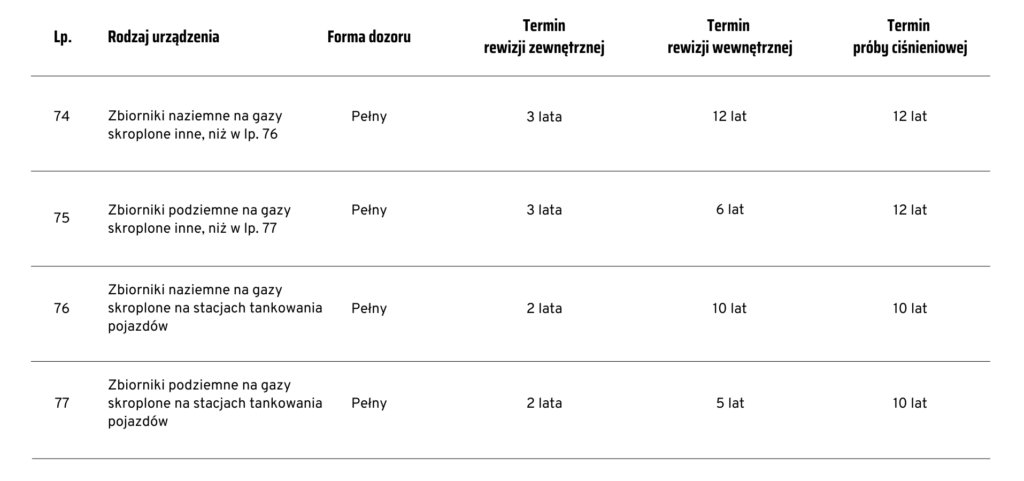
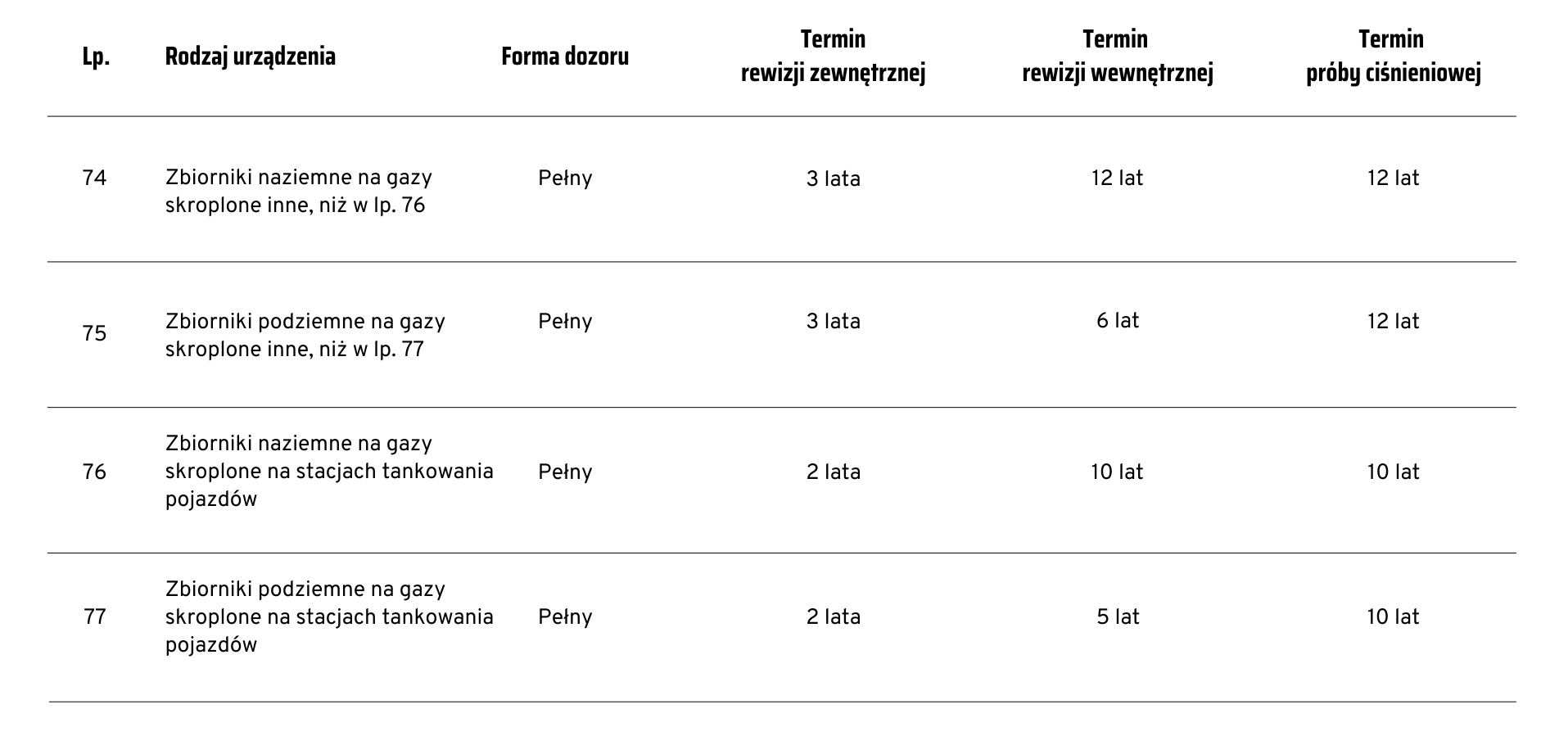
The inspection intervals for the various types of tanks have changed: